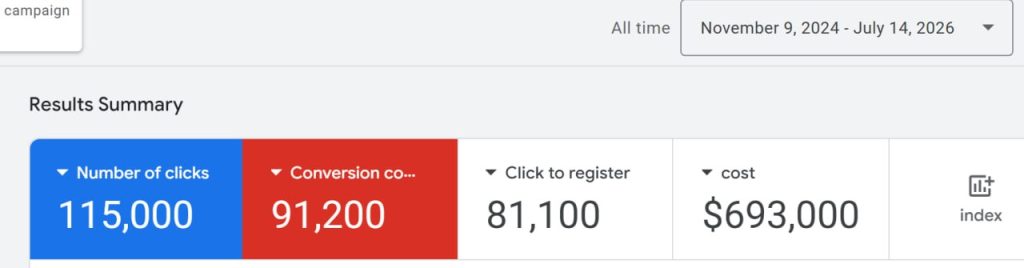
Google Ads Case Study: How $693,000 in Ad Spend Generated 81,100 Registered Users in 20 Months
Google Ads Case Study: How $693,000 in Ad Spend Generated 81,100 Registered Users in 20 Months
In digital marketing, the number of registered users is one of the most critical metrics for measuring advertising effectiveness. This article presents a real‑world Google Ads case study where, over a period of less than two years, a strategic and continuously optimised advertising campaign successfully acquired 81,100 registered users. As a Google Ads specialist with over five years of hands‑on experience and more than $1 million in total ad spend, I will break down the methodology across five key dimensions: account structure, conversion tracking, audience targeting, bidding strategy, and creative optimisation.
1. Project Background and Challenges
The client is a business that has set “registration” as its primary conversion goal and had already been running its Google Ads account for two years prior to this campaign. When we took over the account, the main challenges were: high cost per acquisition (CPA), a loosely organised account structure, imprecise conversion tracking, and limited audience data to support targeting.
The core objective was clear: maximise the number of registered users while keeping CPA under control.
The campaign ran from November 9, 2024, to July 14, 2026 – a 20‑month window that covered a full seasonal cycle, providing ample data for the Google algorithm to learn and optimise.
2. Strategy Breakdown
a. Account Structure: Three‑Tier Pyramid Model
Following the 2025 best practices for Google Ads, I built the account using a three‑tier pyramid structure based on the marketing funnel:
- Bottom layer (Awareness): Used the Google Display Network and YouTube video ads to increase brand exposure and reach potential audiences. The Display Network covers over 35 million websites and apps, reaching 90% of internet users.
- Middle layer (Consideration): Leveraged search ads to capture users with high‑intent queries (e.g., “platform sign‑up”, “tool review”, “best X for Y”) and guide them towards the registration flow.
- Top layer (Conversion): Retargeted users who had visited the website but did not complete registration, using remarketing lists to reduce drop‑off.
b. Conversion Tracking: The Foundation of All Optimisation
Without accurate and complete conversion data, Google’s algorithms operate in the dark. I focused on three actions:
- Set “registration” as the primary conversion action in Google Ads and simultaneously defined it as a key event in Google Analytics 4 (GA4) to ensure cross‑device and cross‑channel tracking.
- Imported GA4 conversion events into Google Ads to avoid “last‑click” bias.
- Ensured all campaigns used the account‑default conversion goals, allowing different campaigns to learn from each other’s conversion data and improve bidding.
c. Audience Targeting: First‑Party Data as a Strategic Asset
In an era of stricter privacy regulations, first‑party data is invaluable. I uploaded the client’s existing customer lists and segmented them into granular audiences (e.g., registered users, active users, high‑value users). We then tailored creative messages for each segment, which significantly boosted conversion rates.
We also leveraged Google’s Customer Match feature to create lookalike audiences based on uploaded data (emails, app IDs), enabling us to acquire new users who shared similar characteristics with our best existing customers.
d. Smart Bidding: From Maximise Conversions to Target CPA
Since the account already had a solid history of conversion data, we could adopt smart bidding from day one. The two‑phase approach was:
- Phase 1: Used “Maximise Conversions” bidding to allow the system to quickly accumulate conversion data and explore the most responsive user segments.
- Phase 2: Once conversion volume stabilised, switched to “Target CPA” bidding to cap acquisition costs within the predefined range.
e. Creative and Assets: Diversity Drives Scale
In Google Ads, asset quality directly impacts ad reach and conversion efficiency – especially for App campaigns where the system automatically combines assets. I ensured each ad group contained at least:
- 2+ landscape video assets
- 4+ portrait image assets
- Multiple headline variations with different angles
Additionally, I incorporated high‑frequency keywords from the ad group into headlines to improve ad relevance and user search intent match.
3. Key Results
After 20 months of systematic execution and continuous refinement, the campaign delivered the following results:
| Metric | Value |
|---|---|
| Total Clicks | 115,000 |
| Total Conversions (registrations) | 91,200 |
| Click‑to‑Registration Conversions | 81,100 |
| Total Ad Spend | $693,000 |
| Cost Per Acquisition (CPA) per Registration | ~$8.5 |
Achieving 81,100 registered users validated the effectiveness of the combined strategy.
4. Key Takeaways
1. Conversion Tracking Is the Soul of Advertising
The ultimate goal is not clicks but conversions. Without proper tracking, you are essentially flying blind. I strongly recommend every advertiser ensure that conversion tags are correctly installed and that all core events are fully reported back to Google Ads before launching any campaign.
2. First‑Party Data Is Your Deepest Moat
As third‑party data becomes increasingly restricted, your own customer lists, emails, and phone numbers are strategic assets that competitors cannot replicate. Make full use of Customer Match and similar audiences to significantly improve new customer acquisition.
3. Smart Bidding Requires Data Volume
Smart bidding strategies only work well when there is sufficient conversion history. I advise switching to Target CPA or Target ROAS only after you have at least 30–50 conversions per month per campaign.
4. Account Structure Determines Optimisation Potential
A logical account structure (e.g., by funnel stage or product line) is the prerequisite for all subsequent optimisations. A poorly structured account makes any optimisation effort difficult to implement.
Conclusion
The acquisition of 81,100 registered users was not a stroke of luck – it was the result of a systematic strategy, precise execution, and continuous optimisation. Every element, from account architecture to conversion tracking, from audience segmentation to smart bidding, contributed to the final success.
For businesses currently using or planning to use Google Ads to drive registrations, I hope the strategic framework and data insights shared in this case study provide a valuable reference.
About the author: The author has over five years of Google Ads management experience with a total spend exceeding $8 million. All data presented comes from a real advertising account and the case has been published with the client’s permission.